
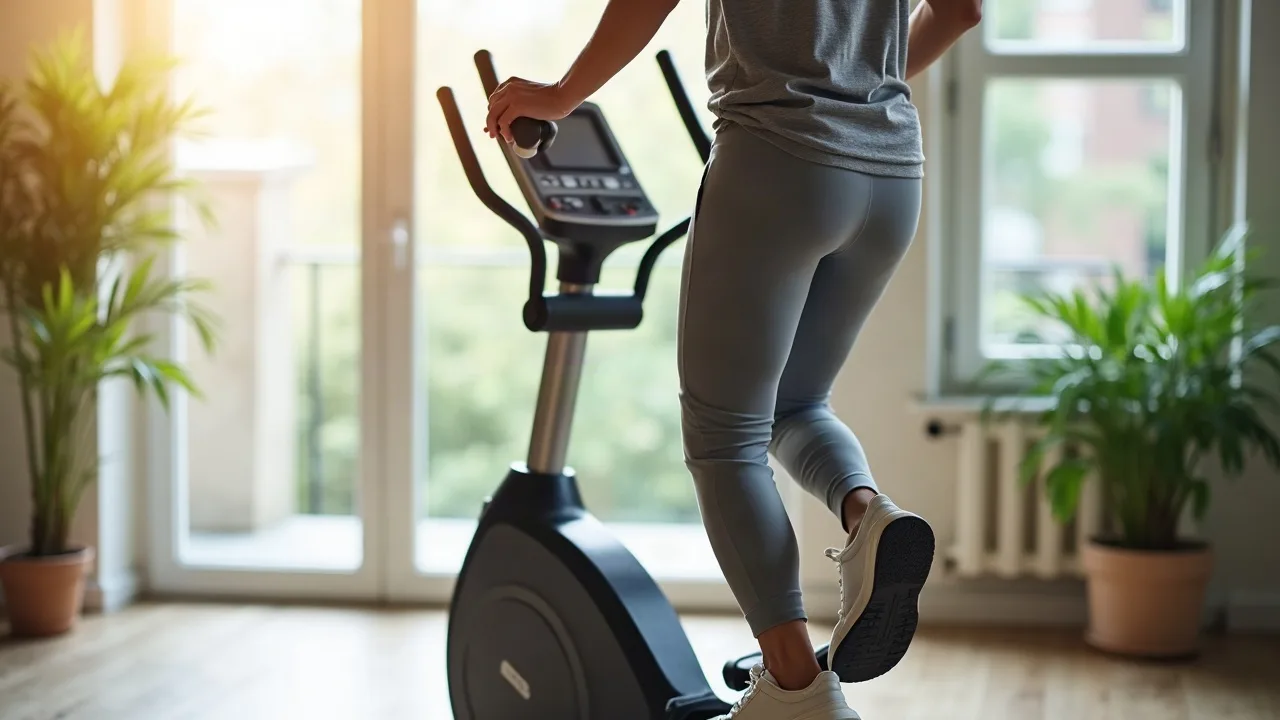
- Upright posture with light hand grip protects back and wrists
- Warm-up, steady main phase and cool-down give a sensible session structure
- Resistance should be raised gradually, not at the expense of technique
Crosstrainers are popular for home training because the movement is low-impact and works the legs, and on most models the arms as well. Many people still use them in a way that wastes effort or puts strain on the back, knees or wrists. The question that comes up most often is simple: how should a cross trainer be used correctly from the first session onwards? The steps below cover set-up, technique, session planning and common errors.
Step 1: Check the set-up before the first session
A stable starting point makes the rest easier. A few checks take only a couple of minutes.
- Position: The machine should stand on a level surface with enough free space behind and beside it. A mat underneath protects the floor and can reduce vibration.
- Stability: If the frame wobbles, the levelling feet, where fitted, should be adjusted. Bolts and pedal fixings are worth checking after assembly and from time to time afterwards.
- Weight limit and stride length: The manufacturer's stated maximum user weight and stride length are listed in the specification. Taller users often find a longer stride more natural, while a shorter one can feel restricted.
- Footwear: Flat, supportive trainers with a non-slip sole are more suitable than soft-soled or worn shoes.
- Power source: Some models need a mains connection for the console, others generate their own power. The instructions show which applies, and the cable should not run where it can be tripped over.
Step 2: Getting on and finding a good posture
Stepping on while the pedals are moving is a common cause of stumbles. The safer sequence is to bring one pedal to its lowest point, step on, hold the handles and then place the other foot on the second pedal.
Body position
- The body is upright, with the head level and the gaze directed forward rather than down at the pedals.
- Shoulders stay relaxed and away from the ears.
- The core is lightly engaged, and the pelvis is neither pushed forward nor tilted back.
- Knees remain slightly bent and point in the same direction as the toes.
Feet and hands
The whole foot should stay in contact with the pedal. Heels that lift noticeably, or toes that grip, usually point to a poorly adjusted stance or an unsuitable stride. On models with moving handles, a light grip is enough. Clenching the handles tires the forearms and tends to pull the shoulders upward. Pushing and pulling with the arms should come from the upper back and arms, not from leaning the whole torso.
Step 3: Building a session
A simple three-part structure suits most people and avoids starting too hard.
- Warm-up: A few minutes at the lowest or a very low resistance level, at a relaxed pace, lets muscles and joints get used to the movement.
- Main phase: Resistance is then raised to a level at which the movement stays smooth and breathing is elevated but controlled. A common rule of thumb is that speaking in short sentences should still be possible during steady-state work.
- Cool-down: Resistance and pace are reduced again for a few minutes until breathing and heart rate settle. Gentle stretching of the calves, thighs and hip flexors can follow.
Magnetic resistance systems, which many home crosstrainers use, are adjusted in levels. The numbering differs between models, so a level on one machine cannot be compared directly with the same number on another. It is more useful to judge resistance by how the movement feels than by the figure on the display.
For progress, it is generally more sensible to extend the duration or the frequency gradually, rather than increasing everything at once. People with health conditions, joint problems or those returning to exercise after a long break may wish to speak to a doctor or physiotherapist before starting.
Using the reverse motion
Many crosstrainers allow pedalling backwards. This shifts the emphasis slightly towards the back of the legs and can add variety to a routine. It is best tried briefly and at low resistance first, as the coordination feels unfamiliar at the start.
Typical mistakes and how to avoid them
- Leaning on the handles: Supporting body weight through the arms reduces the work done by the legs and can strain the wrists. The handles are there for balance.
- Resistance too high too soon: If the stride becomes jerky or the knees feel stressed, resistance is probably above what the technique can handle. Reducing a level or two usually restores a smooth rhythm.
- Looking down: A lowered head rounds the upper back. Fixing the gaze on a point ahead helps to keep the spine long.
- Rocking the upper body: Swinging from side to side to drive the pedals suggests that the movement is coming from the wrong place. A calmer torso with the push coming from the legs is more efficient.
- Skipping the warm-up and cool-down: Starting at full effort or stopping abruptly makes the session less comfortable and offers no benefit.
- Ignoring pain: Muscle fatigue is normal, but sharp or lasting pain in the knees, hips or back is a reason to stop and review technique or seek advice.
- Neglecting maintenance: Dust, loose fixings and unusual noises are easy to overlook. A quick wipe-down and a look at the connections after use helps the machine stay stable and quiet.
Choosing a model that supports good technique
Correct use depends partly on how well the machine fits the user. Stride length, the maximum user weight, the number of resistance levels, noise level and whether the unit folds for storage all vary between models. Manufacturers' descriptions give these details, and comparing them against the space available, the heights of the people using the machine and the intended type of training is more useful than focusing on any single feature. The following products from the comparison are shown for orientation.
Live from the comparison Ranking and prices: as of today 03:25

MERACH Long Stride Cross Trainer, Self-Generating Elliptical Machine for Home Use, Ultra-Q...
- 【Self-Powered System – No Power Outlet Required】This elliptical trainer featur...
- 【47 cm Stride Length-Comfortable and Smooth】The extra-wide 47 cm stride length...
- 【High Weight Capacity of up to 180 kg – Stable and Secure】Our cross trainer fe...
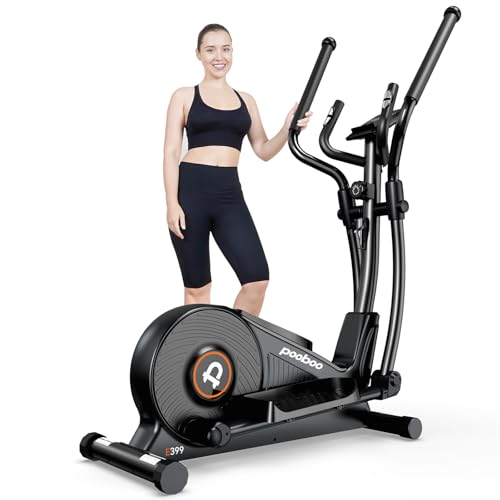
Cross Trainer, Foldable Elliptical Cross Trainer 400 lbs Capacity 16 Level | Ultra-Quiet E...
- 【16-Level Silent Magnetic Resistance for All Fitness Levels】 From gentle rehab...
- 【Ergonomic Design with Perfect Stride & High Weight Capacity】 Experience unpar...
- 【Space-Saving Foldable Design with Transport Wheels】 Conquer limited space wit...

Merach Cross Trainer For Home With 47 Cm Stride Length, Ultra-Quiet Elliptical Trainer Wit...
- 【47 cm Stride Length-Comfortable and Smooth】The extra-wide 47 cm stride length...
- 【High Weight Capacity of up to 180 kg – Stable and Secure】Our cross trainer fe...
- 【8-Level Electromagnetic Resistance】Featuring a 17.6 lb flywheel and a magneti...
Conclusion
Using crosstrainers correctly mostly comes down to a stable set-up, an upright posture with a light hand grip, a structured session and gradual progression. Most of the typical mistakes, such as leaning on the handles or setting the resistance too high, can be corrected with small adjustments. Regular short checks of technique tend to be more helpful than occasional long sessions with poor form.